
Trinidad and Tobago
Express
Who will be president-elect?
¦ Electoral College to vote for Kangaloo or Khan...
PORT OF SPAIN
¦ Ria Taitt
Political Editor
TODAY, Christine Kangaloo is expected to cross a significant milestone in her public journey, moving from Citizen Christine to president-elect Christine.
President of the Senate for the past seven years, Kangaloo resigned her position on Monday, reverting, if only briefly, to the status of simply 'citizen'.
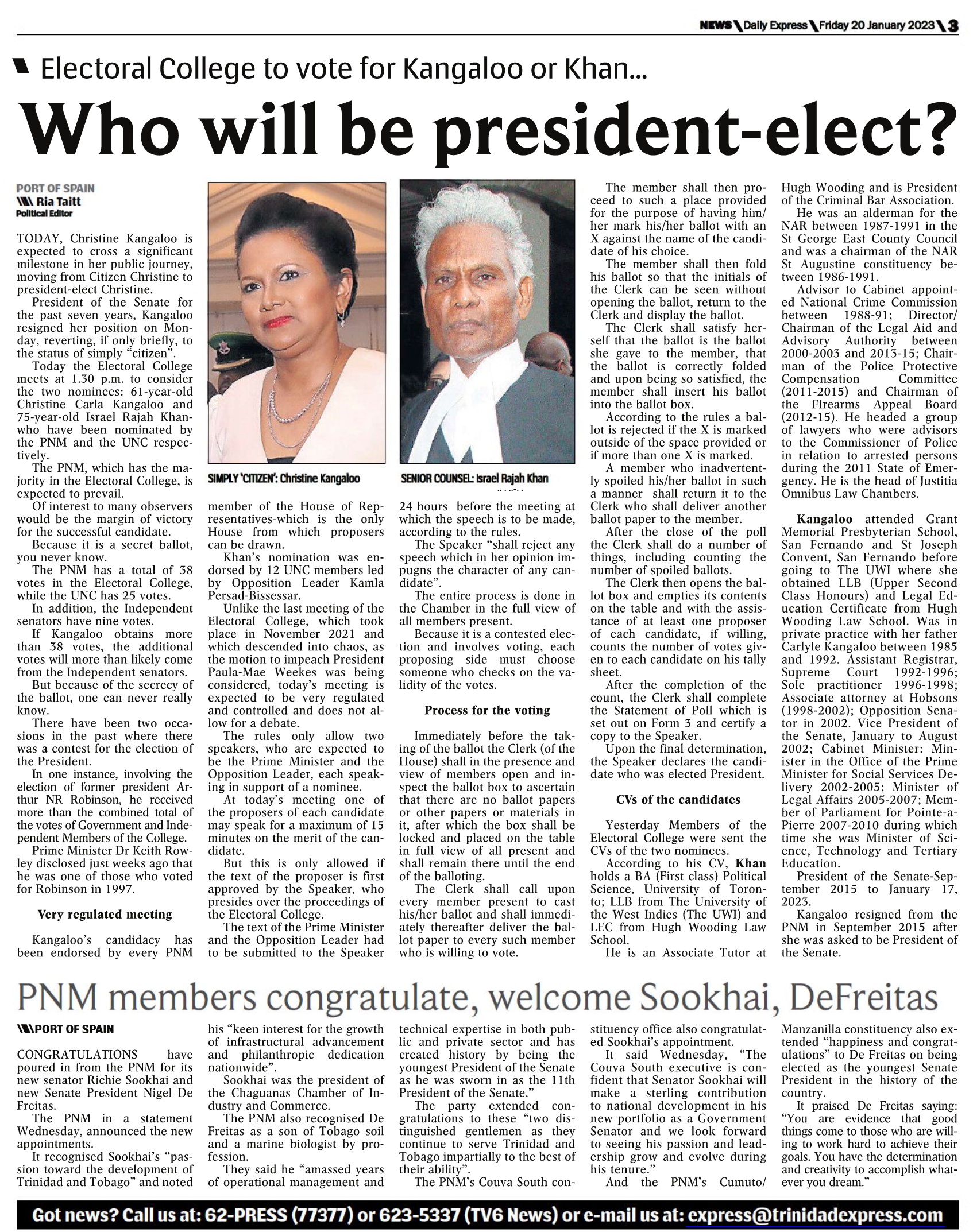
Today the Electoral College meets at 1.30 p.m. to consider the two nominees: 61-year-old Christine Carla Kangaloo and 75-year-old Israel Rajah Khanwho have been nominated by the PNM and the UNC respectively.
The PNM, which has the majority in the Electoral College, is expected to prevail.
Of interest to many observers would be the margin of victory for the successful candidate.
Because it is a secret ballot, you never know.
The PNM has a total of 38 votes in the Electoral College, while the UNC has 25 votes.
In addition, the Independent senators have nine votes.
If Kangaloo obtains more than 38 votes, the additional votes will more than likely come from the Independent senators.
But because of the secrecy of the ballot, one can never really know.
There have been two occasions in the past where there was a contest for the election of the President.
In one instance, involving the election of former president Arthur NR Robinson, he received more than the combined total of the votes of Government and Independent Members of the College.
Prime Minister Dr Keith Rowley disclosed just weeks ago that he was one of those who voted for Robinson in 1997.
Very regulated meeting
Kangaloo's candidacy has been endorsed by every PNM member of the House of Representatives- which is the only House from which proposers can be drawn.
Khan's nomination was endorsed by 12 UNC members led by Opposition Leader Kamla Persad- Bissessar.
Unlike the last meeting of the Electoral College, which took place in November 2021 and which descended into chaos, as the motion to impeach President Paula-Mae Weekes was being considered, today's meeting is expected to be very regulated and controlled and does not allow for a debate.
The rules only allow two speakers, who are expected to be the Prime Minister and the Opposition Leader, each speaking in support of a nominee.
At today's meeting one of the proposers of each candidate may speak for a maximum of 15 minutes on the merit of the candidate.
But this is only allowed if the text of the proposer is first approved by the Speaker, who presides over the proceedings of the Electoral College.
The text of the Prime Minister and the Opposition Leader had to be submitted to the Speaker 24 hours before the meeting at which the speech is to be made, according to the rules.
The Speaker 'shall reject any speech which in her opinion impugns the character of any candidate'.
The entire process is done in the Chamber in the full view of all members present.
Because it is a contested election and involves voting, each proposing side must choose someone who checks on the validity of the votes.
Process for the voting
Immediately before the taking of the ballot the Clerk (of the House) shall in the presence and view of members open and inspect the ballot box to ascertain that there are no ballot papers or other papers or materials in it, after which the box shall be locked and placed on the table in full view of all present and shall remain there until the end of the balloting.
The Clerk shall call upon every member present to cast his/her ballot and shall immediately thereafter deliver the ballot paper to every such member who is willing to vote.
The member shall then proceed to such a place provided for the purpose of having him/ her mark his/her ballot with an X against the name of the candidate of his choice.
The member shall then fold his ballot so that the initials of the Clerk can be seen without opening the ballot, return to the Clerk and display the ballot.
The Clerk shall satisfy herself that the ballot is the ballot she gave to the member, that the ballot is correctly folded and upon being so satisfied, the member shall insert his ballot into the ballot box.
According to the rules a ballot is rejected if the X is marked outside of the space provided or if more than one X is marked.
A member who inadvertently spoiled his/her ballot in such a manner shall return it to the Clerk who shall deliver another
ballot paper to the member.
After the close of the poll the Clerk shall do a number of things, including counting the number of spoiled ballots.
The Clerk then opens the ballot box and empties its contents on the table and with the assistance of at least one proposer of each candidate, if willing, counts the number of votes given to each candidate on his tally sheet.
After the completion of the count, the Clerk shall complete the Statement of Poll which is set out on Form 3 and certify a copy to the Speaker.
Upon the final determination, the Speaker declares the candidate who was elected President.
CVs of the candidates
Yesterday Members of the Electoral College were sent the CVs of the two nominees.
According to his CV, Khan holds a BA (First class) Political Science, University of Toronto; LLB from The University of the West Indies (The UWI) and LEC from Hugh Wooding Law School.
He is an Associate Tutor at Hugh Wooding and is President of the Criminal Bar Association.
He was an alderman for the NAR between 1987-1991 in the St George East County Council and was a chairman of the NAR St Augustine constituency between 1986- 1991. Advisor to Cabinet appointed National Crime Commission between 1988-91; Director/ Chairman of the Legal Aid and Advisory Authority between 2000-2003 and 2013-15; Chairman of the Police Protective Compensation Committee (2011-2015) and Chairman of the FIrearms Appeal Board (2012-15). He headed a group of lawyers who were advisors to the Commissioner of Police in relation to arrested persons during the 2011 State of Emergency. He is the head of Justitia Omnibus Law Chambers.
Kangaloo attended Grant Memorial Presbyterian School, San Fernando and St Joseph Convent, San Fernando before going to The UWI where she obtained LLB (Upper Second Class Honours) and Legal Education Certificate from Hugh Wooding Law School. Was in private practice with her father Carlyle Kangaloo between 1985 and 1992. Assistant Registrar, Supreme Court 1992-1996; Sole practitioner 1996-1998; Associate attorney at Hobsons (1998-2002); Opposition Senator in 2002. Vice President of the Senate, January to August 2002; Cabinet Minister: Minister in the Office of the Prime Minister for Social Services Delivery 2002-2005; Minister of Legal Affairs 2005-2007; Member of Parliament for Pointe-a-Pierre 2007-2010 during which time she was Minister of Science, Technology and Tertiary Education.
President of the Senate-September 2015 to January 17, 2023.
Kangaloo resigned from the PNM in September 2015 after she was asked to be President of the Senate. /
SIMPLY 'CITIZEN': Christine Kangaloo - Photo /
SENIOR COUNSEL: Israel Rajah Khan - Photo