
Trinidad and Tobago
Express
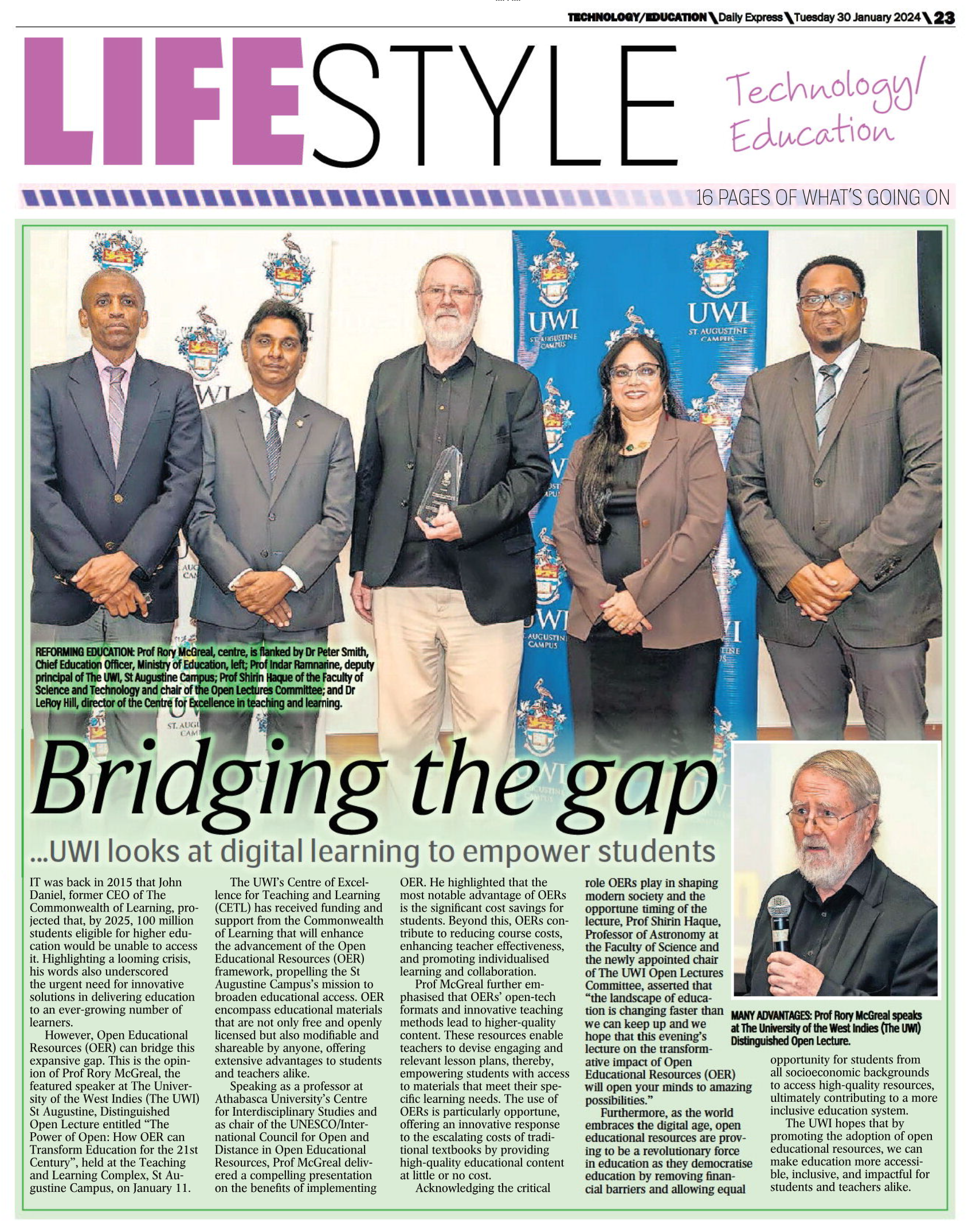
Bridging the gap
...UWI looks at digital learning to empower students
IT was back in 2015 that John Daniel, former CEO of The Commonwealth of Learning, projected that, by 2025, 100 million students eligible for higher education would be unable to access it. Highlighting a looming crisis, his words also underscored the urgent need for innovative solutions in delivering education to an ever-growing number of learners.
However, Open Educational Resources (OER) can bridge this expansive gap. This is the opinion of Prof Rory McGreal, the featured speaker at The University of the West Indies (The UWI) St Augustine, Distinguished Open Lecture entitled 'The Power of Open: How OER can Transform Education for the 21st Century', held at the Teaching and Learning Complex, St Augustine Campus, on January 11.
The UWI's Centre of Excellence for Teaching and Learning (CETL) has received funding and support from the Commonwealth of Learning that will enhance the advancement of the Open Educational Resources (OER) framework, propelling the St Augustine Campus's mission to broaden educational access. OER encompass educational materials that are not only free and openly licensed but also modifiable and shareable by anyone, offering extensive advantages to students and teachers alike.
Speaking as a professor at Athabasca University's Centre for Interdisciplinary Studies and as chair of the UNESCO/International Council for Open and Distance in Open Educational Resources, Prof McGreal delivered a compelling presentation on the benefits of implementing OER. He highlighted that the most notable advantage of OERs is the significant cost savings for students. Beyond this, OERs contribute to reducing course costs, enhancing teacher effectiveness, and promoting individualised learning and collaboration.
Prof McGreal further emphasised that OERs' open-tech formats and innovative teaching methods lead to higher-quality content. These resources enable teachers to devise engaging and relevant lesson plans, thereby, empowering students with access to materials that meet their specific learning needs. The use of OERs is particularly opportune, offering an innovative response to the escalating costs of traditional textbooks by providing high-quality educational content at little or no cost.
Acknowledging the critical role OERs play in shaping modern society and the opportune timing of the lecture, Prof Shirin Haque, Professor of Astronomy at the Faculty of Science and the newly appointed chair of The UWI Open Lectures Committee, asserted that 'the landscape of education is changing faster than we can keep up and we hope that this evening's lecture on the transformative impact of Open Educational Resources (OER) will open your minds to amazing possibilities.'
Furthermore, as the world embraces the digital age, open educational resources are proving to be a revolutionary force in education as they democratise education by removing financial barriers and allowing equal opportunity for students from all socioeconomic backgrounds to access high-quality resources, ultimately contributing to a more inclusive education system.
The UWI hopes that by promoting the adoption of open educational resources, we can make education more accessible, inclusive, and impactful for students and teachers alike. /
REFORMING EDUCATION: Prof Rory McGreal, centre, is flanked by Dr Peter Smith, Chief Education Officer, Ministry of Education, left; Prof Indar Ramnarine, deputy principal of The UWI, St Augustine Campus; Prof Shirin Haque of the Faculty of Science and Technology and chair of the Open Lectures Committee; and Dr LeRoy Hill, director of the Centre for Excellence in teaching and learning. - Photo /
MANY ADVANTAGES: Prof Rory McGreal speaks at The University of the West Indies (The UWI) Distinguished Open Lecture. - Photo /