
Trinidad and Tobago
Guardian
Going after ‘untouched masterminds’ in illegal quarrying
By Shane Superville
Police targeted low-level
participants in the past, but now
...
Efforts to combat illegal quarrying are being
hindered by corrupt State elements and those
fearful of violent intimidation as criminal gangs
have been propping up the operations.
And even as efforts have been made by the T&T
Police Service to tackle the illegal activities, there
is an urgent appeal for serious work to be done by
other State agencies collaborating with the police
to dismantle this complex operation.
The head of the Multi-Agency Task Force (MATF),
ASP Leon Haynes, in an interview with Guardian
Media on Wednesday, emphasised the need for
institutions to adjust and keep up with the everincreasing resourcefulness of criminals, who
have evolved to take advantage of the
inadequacies of some agencies.
ASP Haynes said this may require empowering
these agencies to take a more resolute stance
against illegal quarrying.
“I just think a lot of the agencies have not
developed to the times and have not understood
how Trinidad has changed and changed to treat
with the position society has reached. The
agencies are still at 15 or 20 years ago.
Some of the agencies that were unarmed back in
the day may have to be armed now with the
changes in society.”
He noted, however, that with these enhanced
capacities, proper oversight would be needed to
ensure that duties are honestly fulfilled.
Referring to the Professional Standards Bureau
(PSB) and the Police Complaints Authority (PCA),
which holds police officers accountable, Haynes
suggested similar mechanisms for officials in the
Forestry Division or the Commissioner of State
Lands.
Chief of Defence Staff Air Vice Marshall Darryl
Daniel said that while the Defence Force has
assisted the police and other State agencies in
dealing with these activities, he admitted that
even with the Defence Force’s support, it is
difficult.
“You would appreciate that other entities need to
do some serious work to understand who is the
owner of the quarry and the licence it has to get.
It’s multifaceted in terms of what’s needed to
address this effectively.”
Now following the money
Since 2018, at least 19 people have been charged
with offences related to illegal quarrying.
However, those charged are still before the
courts.
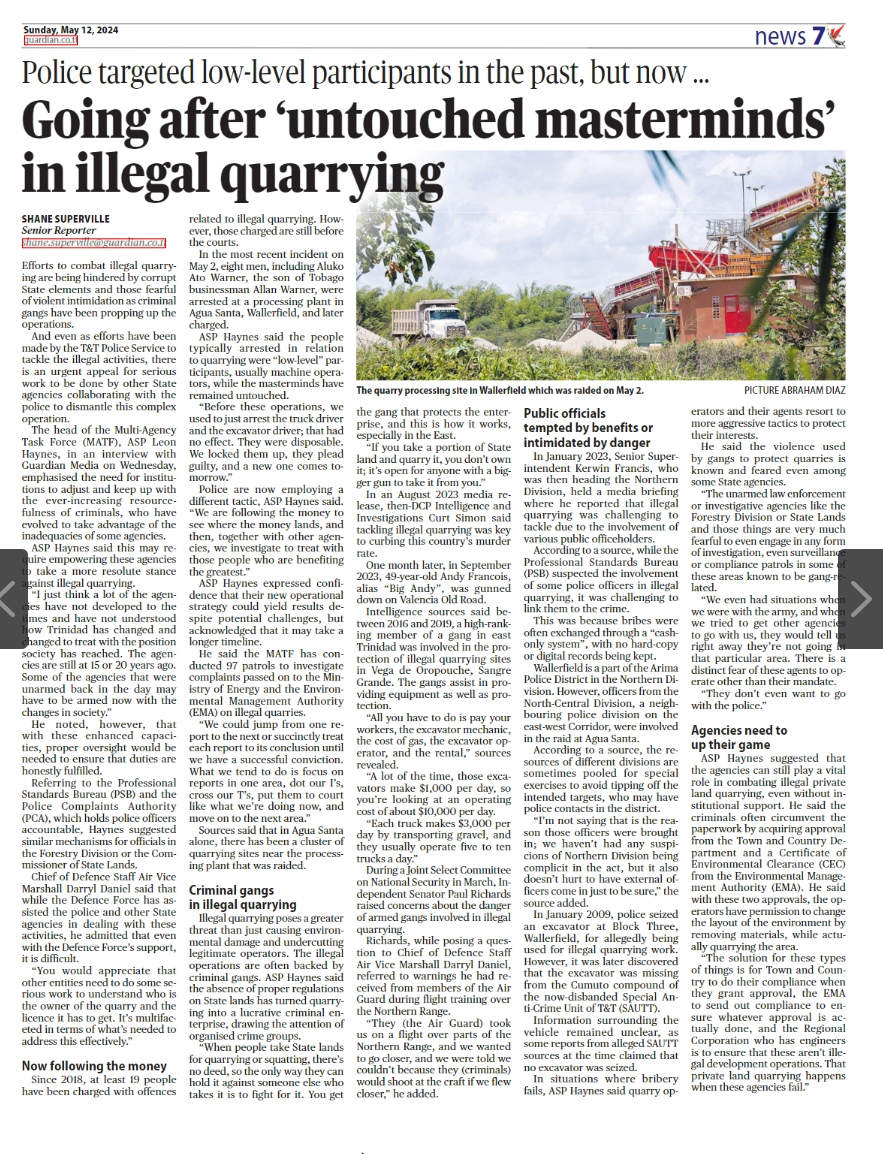
In the most recent incident on May 2, eight men,
including Aluko Ato Warner, the son of Tobago
businessman Allan Warner, were arrested at a
processing plant in Agua Santa, Wallerfield, and
later charged.
ASP Haynes said the people typically arrested in
relation to quarrying were “low-level”
participants, usually machine operators, while
the masterminds have remained untouched.
“Before these operations, we used to just arrest
the truck driver and the excavator driver; that
had no effect. They were disposable
We locked them up, they plead guilty, and a new
one comes tomorrow.”
Police are now employing a different tactic, ASP
Haynes said.
“We are following the money to see where the
money lands, and then, together with other
agencies, we investigate to treat with those
people who are benefiting the greatest.”
ASP Haynes expressed confidence that their new
operational strategy could yield results despite
potential challenges, but acknowledged that it
may take a longer timeline.
He said the MATF has conducted 97 patrols to
investigate complaints passed on to the Ministry
of Energy and the Environmental Management
Authority (EMA) on illegal quarries.
“We could jump from one report to the next or
succinctly treat each report to its conclusion until
we have a successful conviction.
What we tend to do is focus on reports in one
area, dot our I’s, cross our T’s, put them to court
like what we’re doing now, and move on to the
next area.”
Sources said that in Agua Santa alone, there has
been a cluster of quarrying sites near the
processing plant that was raided.
Criminal gangs in illegal quarrying
Illegal quarrying poses a greater threat than just
causing environmental damage and undercutting
legitimate operators. The illegal operations are
often backed by criminal gangs. ASP Haynes said
the absence of proper regulations on State lands
has turned quarrying into a lucrative criminal
enterprise, drawing the attention of organised
crime groups.
“When people take State lands for quarrying or
squatting, there’s no deed, so the only way they
can hold it against someone else who takes it is
to fight for it. You get the gang that protects the
enterprise, and this is how it works, especially in
the East.
“If you take a portion of State land and quarry it,
you don’t own it; it’s open for anyone with a
bigger gun to take it from you.”
In an August 2023 media release, then-DCP
Intelligence and Investigations Curt Simon said
tackling illegal quarrying was key to curbing this
country’s murder rate.
One month later, in September 2023, 49-yearold Andy Francois, alias “Big Andy”, was gunned
down on Valencia Old Road.
Intelligence sources said between 2016 and 2019,
a high-ranking member of a gang in east Trinidad
was involved in the protection of illegal quarrying
sites in Vega de Oropouche, Sangre Grande. The
gangs assist in providing equipment as well as
protection.
“All you have to do is pay your workers, the
excavator mechanic, the cost of gas, the
excavator operator, and the rental,” sources
revealed.
“A lot of the time, those excavators make $1,000
per day, so you’re looking at an operating cost of
about $10,000 per day.
“Each truck makes $3,000 per day by
transporting gravel, and they usually operate five
to ten trucks a day.”
During a Joint Select Committee on National
Security in March, Independent Senator Paul
Richards raised concerns about the danger of
armed gangs involved in illegal quarrying.
Richards, while posing a question to Chief of
Defence Staff Air Vice Marshall Darryl Daniel,
referred to warnings he had received from
members of the Air Guard during flight training
over the Northern Range.
“They (the Air Guard) took us on a flight over
parts of the Northern Range, and we wanted to go
closer, and we were told we couldn’t because they
(criminals) would shoot at the craft if we flew
closer,” he added.
Public officials tempted by benefits or
intimidated by danger
In January 2023, Senior Superintendent Kerwin
Francis, who was then heading the Northern
Division, held a media briefing where he reported
that illegal quarrying was challenging to tackle
due to the involvement of various public
officeholders.
According to a source, while the Professional
Standards Bureau (PSB) suspected the
involvement of some police officers in illegal
quarrying, it was challenging to link them to the
crime.
This was because bribes were often exchanged
through a “cashonly system”, with no hard-copy
or digital records being kept.
Wallerfield is a part of the Arima Police District in
the Northern Division.
However, officers from the North-Central
Division, a neighbouring police division on the
east-west Corridor, were involved in the raid at
Agua Santa.
According to a source, the resources of different
divisions are sometimes pooled for special
exercises to avoid tipping off the intended
targets, who may have police contacts in the
district.
“I’m not saying that is the reason those officers
were brought in; we haven’t had any suspicions
of Northern Division being complicit in the act,
but it also doesn’t hurt to have external officers
come in just to be sure,” the source added.
In January 2009, police seized an excavator at
Block Three, Wallerfield, for allegedly being used
for illegal quarrying work.
However, it was later discovered that the
excavator was missing from the Cumuto
compound of the now-disbanded Special AntiCrime Unit of T&T (SAUTT).
Information surrounding the vehicle remained
unclear, as some reports from alleged SAUTT
sources at the time claimed that no excavator was
seized.
In situations where bribery fails, ASP Haynes said
quarry operators and their agents resort to more
aggressive tactics to protect their interests.
He said the violence used by gangs to protect
quarries is known and feared even among some
State agencies.
“The unarmed law enforcement or investigative
agencies like the Forestry Division or State Lands
and those things are very much fearful to even
engage in any form of investigation, even
surveillance or compliance patrols in some of
these areas known to be gang-related.
“We even had situations when we were with the
army, and when we tried to get other agencies to
go with us, they would tell us right away they’re
not going in that particular area. There is a
distinct fear of these agents to operate other than
their mandate.
“They don’t even want to go with the police.”
Agencies need to up their game
ASP Haynes suggested that the agencies can still
play a vital role in combating illegal private land
quarrying, even without institutional support. He
said the criminals often circumvent the
paperwork by acquiring approval from the Town
and Country Department and a Certificate of
Environmental Clearance (CEC) from the
Environmental Management Authority (EMA). He
said with these two approvals, the operators have
permission to change the layout of the
environment by removing materials, while
actually quarrying the area.
“The solution for these types of things is for
Town and Country to do their compliance when
they grant approval, the EMA to send out
compliance to ensure whatever approval is
actually done, and the Regional Corporation who
has engineers is to ensure that these aren’t
illegal development operations. That private land
quarrying happens when these agencies fail.”
PICTURE ABRAHAM DIAZ-
The quarry processing site in Wallerfield which
was raided on May 2. /