
Jamaica
Jamaica Star
Dad’s death inspires son to specialise in cancer treatment
When Dr Kern
Pemberton moved
to Jamaica at age
18 to pursue his dreams of
becoming a doctor, little did
he know that tragedy would
shape his path in unexpected
ways.
When Pemberton left his
homeland of Trinidad
and Tobago to
study at The
University of
the West
Indies (UWI), he planned on
acquiring his Bachelor of Medicine
and Bachelor of Surgery degrees,
while pursing studies in music
because he dreamt of being ‘the
singing doctor’. However, three
years into his studies, his father
succumbed to colon cancer at age
53. This devastating yet profound
experience ignited a fierce passion
within Pemberton, guiding him to
specialise in radiation oncology.
“I wanted to understand more
about what happened and I
wanted to understand more about
how I could contribute to cancer
development in the future,”
Pemberton said. He said he also
wanted to understand
the background
of cancer
patients as
well as help
them and
their families
with the
challenges of
battling the
disease.
“I really wanted to have that
connection or be that person that
can tell someone that it’s going
to be okay, because sometimes I
remember when I wanted to be
the person who was told that it was
going to be okay,” said Pemberton.
After completing studies at The
UWI, Pemberton attended the
University of Cape Town in South
Africa and studied radiation and
clinical oncology for four years,
before returning to Jamaica,
which has relatively few radiation
oncologists.
“So it is a sort of developing field, a
field that is in need because radiation
has instilled itself as one of the pillars
of treatment in cancers. So therefore,
knowing that the area is underserved,
knowing that the technology needs
to be developed, I thought it was my
obligation to come back and make
sure I’m part of the development
process,” said Pemberton.
As a radiation oncologist,
Pemberton, 33, treats cancer
patients with rays to damage the
DNA of cancer cells which prevents
the cancer from spreading.
“Colloquially, what I tell patients is
that it [radiation treatment] causes
the cancer cells to sort of break up,
so therefore the cancer cells will
die off eventually and the tumour
disappears. Sometimes we give it to
areas where cancers were [located]
just in case there are any tumour
cells remaining that we can’t see
with the naked eye to get rid of
such,” Pemberton explained. He
said this form of treatment is
dependent on the type of cancer
and its location in the body. He
also told THE STAR that his focus
is not eradicating the disease, but
rather ensuring that his patients’
quality of life is maintained or
regained.
“Often you would find that a
number of patients cannot be
cured of their cancers. However,
when they get to therapy, it’s
to help with things like pain,
bleeding and discomfort. So
therefore, it’s not always
about the tumour,
it’s about the
person in front
of us and that
is what I really
like about it,”
Pemberton
explained. “It
really gives me
an opportunity to
relate to patients,
it gives me an opportunity see
somebody come with a frown that
turns into a smile.”
He added that for him and other
oncologists, working with cancer
patients is its own form of therapy
because of the many life lessons
they teach.
“You get to see persons
from different socio-economic
backgrounds, you get to understand
different challenges that persons
may face, and it’s not just the
face value. There is always a story
behind it,” Pemberton explained,
adding that the most powerful life
lesson he’s learnt from his patients
is that he is not God and cannot
predict every outcome.
“I often tell patients, even
though you’ve been diagnosed
with this sort of illness and
someone tells you that you have
a terminal illness, you cannot play
God. You cannot predict what is
going to happen. Therefore, every
day we need to live our lives as if
it’s the last. We need to actually
ensure that we treat persons with
respect and we need to sort of
appreciate that there is someone
out there who determines what the
final answer is,” said Pemberton.
He advised those interested in
pursuing a career in this field to
ensure they do their research and
have a passion for helping others
and developing their country.
Photo: Antoine Lodge
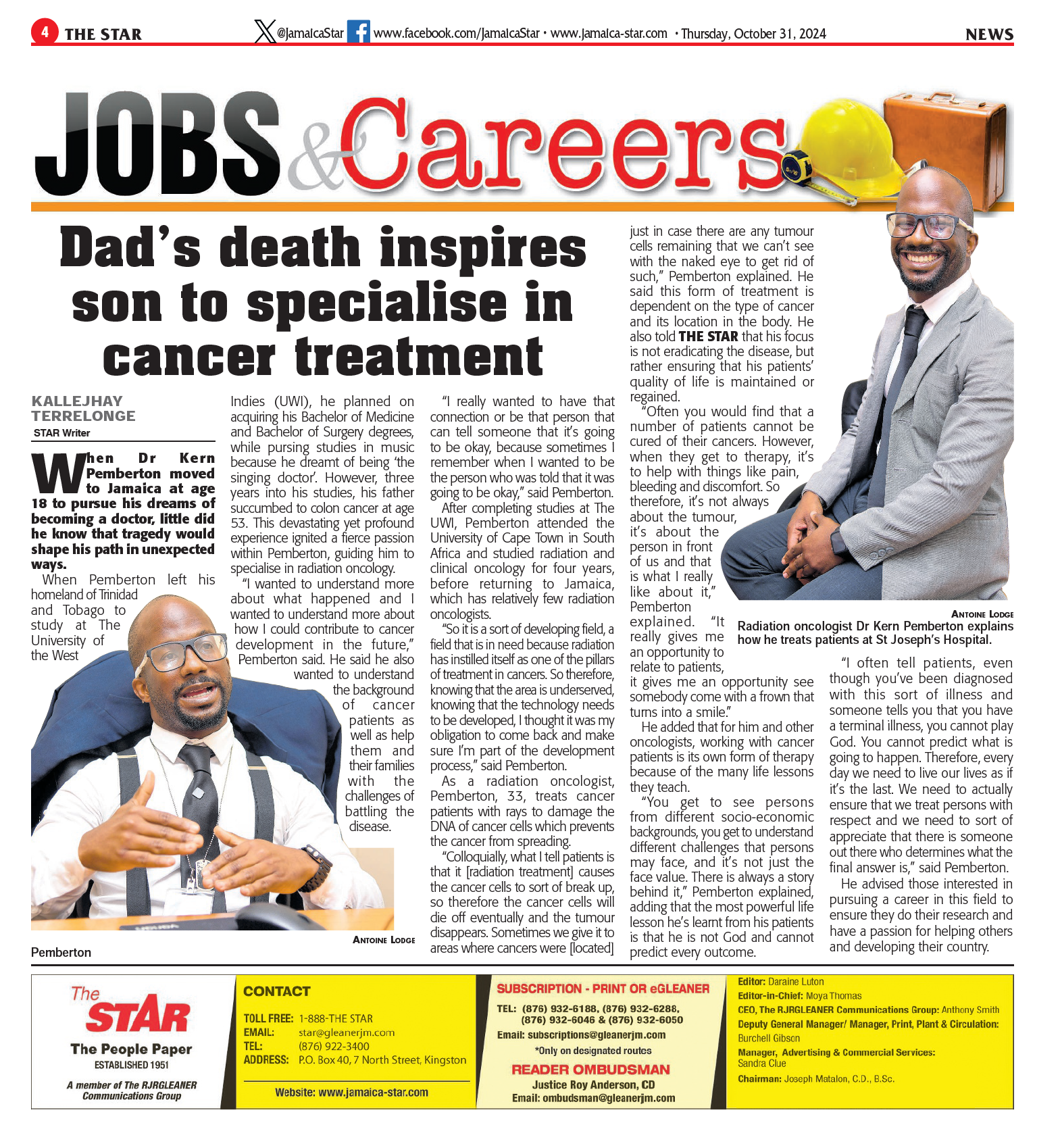
Photo: Radiation oncologist Dr Kern Pemberton explains
how he treats patients at St Joseph’s Hospital.