
Trinidad and Tobago
Express
Aventa CEO rejects monopoly allegations
PORT OF SPAIN
BY MELISSA MAYNARD melissa.maynard @trinidadexpress.com
AVENTA Trinidad and Tobago, a major pharmaceutical distributor, is pushing back against claims of monopolistic practices amid rising scrutiny of pharmaceutical supply chains, pricing structures, and market dominance. The company maintains that its operations are compliant, data-driven, and focused on patient safety.
In an interview with the Sunday Express Business, Aventa T& T, formerly known as Smith Robertson, addressed growing concerns about its perceived dominance in the market.
Aventa Group chief executive officer James Walker rejected the monopoly claims, describing them as inaccurate and unsupported by data. He said assertions that Aventa controls the market are 'simply based on people's opinions'.
'Typically, we have the Fair Trade Commission in Trinidad and Tobago which would review transactions and review what businesses do to ensure it's not creating an adverse position for the customer at the end of the day,' he said.
Dispelling what he called unfounded notions, Walker added: 'If someone comes...and says Aventa has a monopoly share in the market, that is not a fact, that is someone's opinion.'
To illustrate the point, he said: 'Someone who says Aventa represents 75% of the pharma companies in the world, that is not fact-based. The number is 30% of the top 50. So, Aventa does have relationships with 30% of the top 50 by revenue companies that produce these medications in the world.'
Walker outlined the structural differences between the public and private pharmaceutical markets in Trinidad and Tobago, noting that Aventa operates in both sectors.
'The public trade is more like product that goes to clinics and public sector, which is a different scale as well. Some of these much larger orders go to their warehouse and then they distribute it to their respective facilities, etc. So, it's a bit of a different make-up,' he said.
He explained the public procurement process, noting that all suppliers go through a tendering system. 'The public business, in the way that the public business works in Trinidad, is that we have tenders, and we submit into tenders like any other supplier would, or distributor of the product. And they're awarded a certain share of the business, whether if they have the best price for the product that's listed for tender,' he said.
Walker emphasised the transparency of this process. 'And that's publicly available data. So, anyone can sort of see what the entity shares with that public business. And it's gone down, much to my chagrin, in the last sort of ten years.'
Regarding the current contract cycle, he said: 'The last tender was a two-year tender, which was a 2023 to 2025 business. We had 34.3% of that tender award.'
However, actual sales may exceed that allocation due to procurement gaps. 'You have the tender award, but then you also have where, let's say, one of the persons won the tender award, but they couldn't supply it because they got an issue with some production wherever the product was coming from or some other issue.'
In those cases, the Government may seek alternatives. 'The Government will go to another distributor and say, 'Hey, this company cannot supply this product. Do you have an equivalent product? Do you have a generic version of it?' And they'll ask questions, and they'll look around for another source. So, from time to time, they will come to us.'
He added: 'And so you end up, you may sell other products that you weren't awarded on the tender because there's a supplemental process that then has to happen. Or some other procurement, emergency procurement that might be required.'
As for estimating Aventa's total market share in the public sector, Walker acknowledged the difficulty. 'So, it's a bit harder to know what the total, what our share of the total government sales are, to be honest.'
'Not hand-picked'
Rodney Balroop, head of Aventa's Pharmaceutical Division, reinforced the integrity of the process.
'It is a transparent process. It is done with all distributors. It's not that the Government handpicks anybody, and you submit your prices as normal. They do the same review as in a normal tender, so everything is completely transparent and according to the Procurement Act of Trinidad and Tobago.'
In the private market, pharmacies choose from multiple suppliers. Walker said the company relies on client feedback to gauge market share.
'You tell us what our share is of what we sell to you in your own business.'
He added that customers are under no obligation to purchase fixed amounts from Aventa.
'Generally speaking, the customers have options because we are not the only distributors in the country.'
He also addressed the company's ability to respond to market gaps.
'You have to also recognise some of the reasons why the government might go to other distributors and why Aventa might win that supplemental business is because we have the depth of relationships with the suppliers. We do represent many suppliers who do have operations around the world; we can tap into other sources.'
Aventa is now part of a regional network operating in Barbados, Jamaica, Curaçao, Aruba, Guyana, St Lucia, and St Vincent, expanding its reach 'if we need to fill a particular gap in the market', according to Walker.
'Not inflating prices'
On pricing, Walker addressed public criticism suggesting Aventa was inflating prices, calling such claims inaccurate. He pointed to the limited pharmaceutical production capacity within the Caribbean.
'In fact, within our group, we have Carlisle Laboratories in Barbados, which is one of the biggest pharmaceutical manufacturers in the English-speaking Caribbean, and we produce a range of products, over-the-counter products... as well as generic products.'
As part of the Agostini Group of Companies, Aventa imports most of its pharmaceuticals, especially innovative treatments not manufactured locally. Prices, Walker said, are set based on international sourcing costs, which have risen due to global inflation, manufacturing pressures, and increased demand for branded drugs.
'What typically happens for any distributor-you receive a product, you buy a product, add a particular mark-up to cover your cost and to cover your profitability, and you sell that,' he explained.
'Some of the naysayers fail to realise how international pharmaceutical pricing evolved over time.'
He added that while some perceive distributors as profiting more, actual margins tell a different story.
'We in our business monitor the margins that we make. The margins that we have made since 2017...have been within a 2%-point range and, in fact, it has been declining year on year for the last five years. So, our effective mark-up for the markets in Trinidad has literally slightly declined,' he said.
'I mean, investors don't want to hear this, but for good reasons. There are more competitors in the market, there are more options out there for people, there are more generics coming at a lower cost. We have to actually find ways to eat into our profit to remain competitive in some product categories.'
He maintained that price gouging does not align with the company's financial reality.
While acknowledging rising prices, Aventa attributed them to global cost factors rather than local profiteering. The company also pointed to its expanding portfolio of generics as a way to support more affordable health care.
On the issue of illegal or unregistered pharmaceuticals entering the market, Aventa took a strong stance.
'Illegal pharmaceuticals are risky to lives. They may not have been handled properly, they may not have been kept in certain conditions, they may be fake products... that's a huge problem.' Walker noted that this is not only a local issue but a global one.
Addressing tensions with the Pharmacy Board, including opposition to the proposed 90-day prescription fulfilment policy, Aventa said it is actively engaged in industry discussions through the Chamber of Commerce's Healthcare Committee.
The company reaffirmed its commitment to transparency, citing its status as part of the publicly listed Agostini Group, which subjects it to rigorous oversight.
To further underscore its compliance and standards, Aventa facilitated a tour of its facilities.
Stakeholder meeting
On Thursday, Heath Minister Dr Lackram Bodoe convened a meeting with the Medical Board of Trinidad and Tobago, the Pharmacy Board of Trinidad and Tobago, and the Trinidad and Tobago Chamber of Industry and Commerce to address concerns regarding the recent issuance of cease-and-desist letters to pharmaceutical wholesalers and distributors supplying specialty drugs directly to patients.
The discussions centred on ensuring uninterrupted patient access to critical medications used in the treatment of cancer, gastrointestinal disorders, and other complex conditions, a joint release said.
'The parties agreed on a resolution utilising a collaborative pathway over the next 30 days to regularise distribution practices without disrupting patient care. As a first step, the Pharmacy Board has committed to conducting a national assessment to evaluate the state of readiness of pharmacies to dispense the medications referred to above.
'Distributors in turn will assess and report to the Pharmacy Board, the specific challenges regarding distribution of these medications to Pharmacies. The resolution will be actively pursued with a concerted effort from both distributors and pharmacies.
'A follow-up meeting will be convened upon completion of these assessments, and further steps will be taken to ensure compliance with the existing legislative framework, within this 30-day period,' it said.
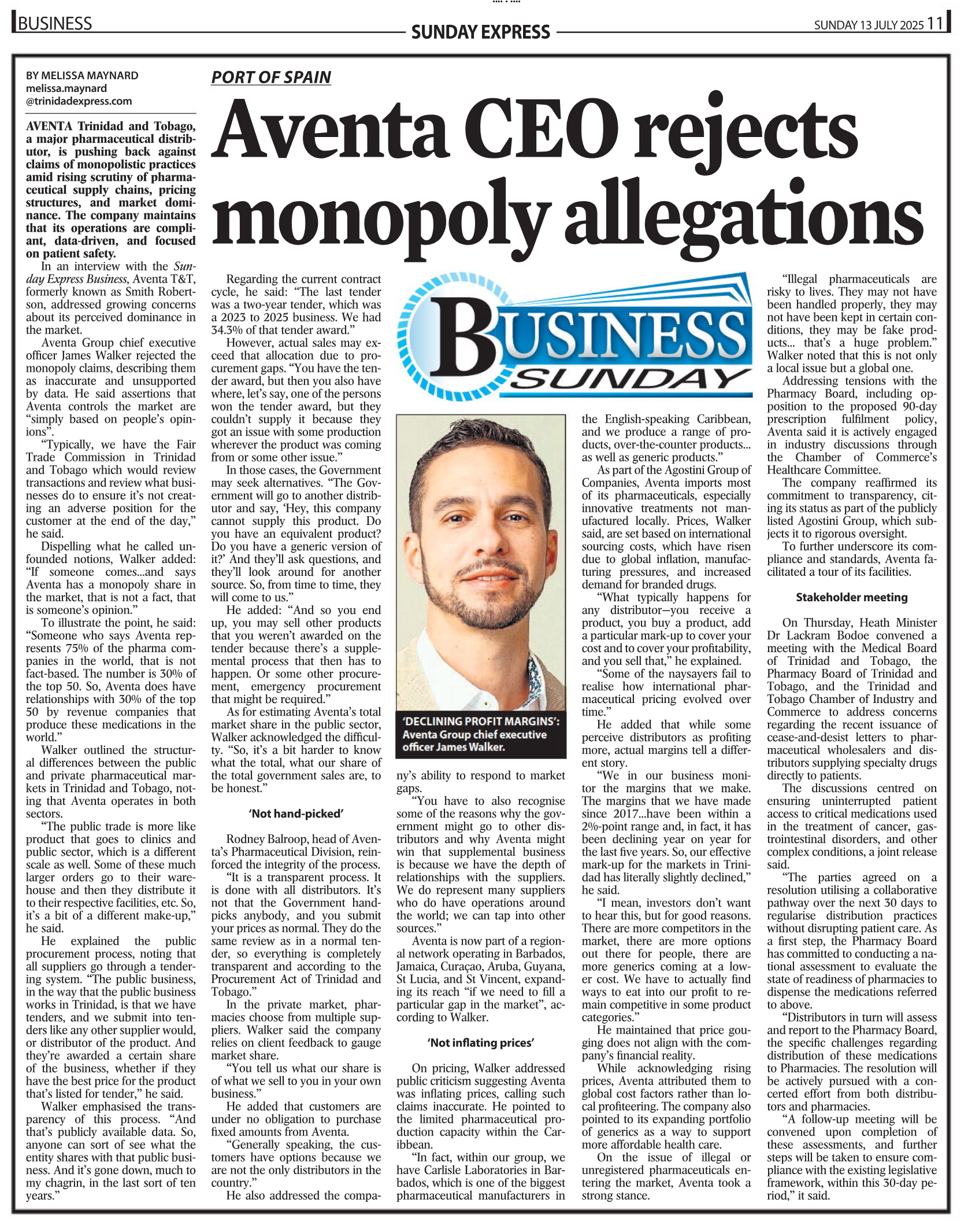
Photo: 'DECLINING PROFIT MARGINS': Aventa Group chief executive officer James Walker.